

From social identity research to leadership in practice.
What is identity leadership?
Identity leadership is a way of understanding leadership not as something leaders do to people, but as something they do with them.
Rather than focusing on individual traits, styles, or charisma, identity leadership explains how leaders mobilise and sustain a shared sense of “us” that enables people to work together effectively.
Decades of research show that leadership is most effective when leaders:
Create and craft a shared social identity
Act in ways that represent and advance that identity
Embed it in everyday practices and structures
This work sits within the social identity approach to leadership, drawing on Social Identity Theory and Self-Categorisation Theory.
Social identity approach
Social Identity Theory (Tajfel & Tuner, 1979) & Self-Categorisation Theory (Turner et al., 1987)


The four elements of identity leadership
The CARE model captures four distinct but complementary elements through which leaders can mobilise a shared sense of “us”.
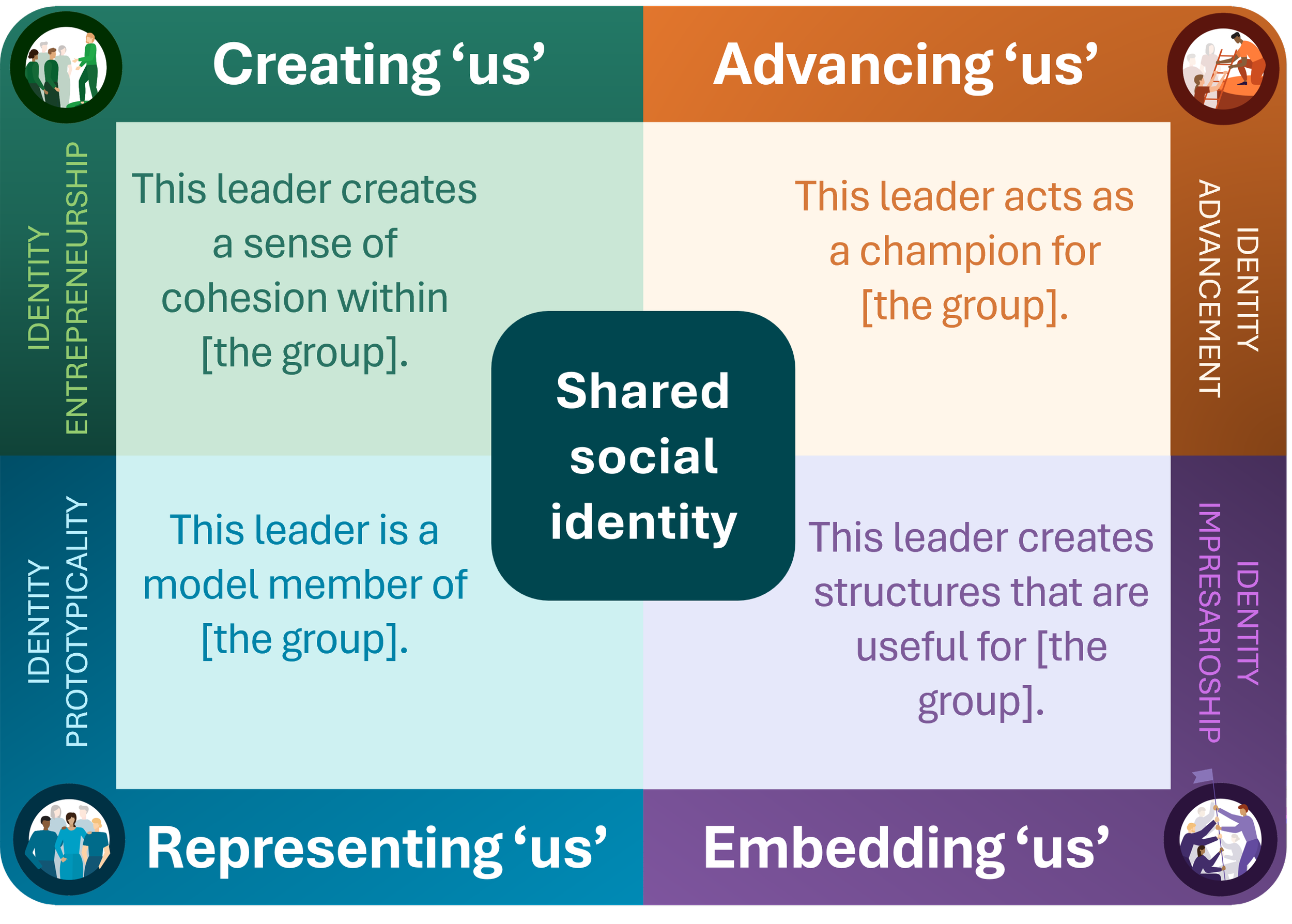
Measuring identity leadership
The Identity Leadership Inventory (ILI) (Steffens et al., 2014) is a psychometrically validated tool used to assess the extent to which leaders enact the four elements of identity leadership.
The ILI captures perceptions from both leaders and team members, providing a robust picture of leadership as a shared social process.
Across large-scale international studies, identity leadership has been shown to predict:

Stronger group identification
Greater trust in leaders
Higher job satisfaction
Increased innovation
Improved citizenship behaviours
Reduced burnout
Importantly, these effects hold above and beyond other established leadership constructs, including transformational, authentic, and leader–member exchange approaches.
Identity leadership in practice
Identity leadership has been studied extensively across real-world settings, demonstrating its relevance well beyond the laboratory and across diverse organisational challenges.
Creating belonging in schools
When school leaders actively build a shared sense of “who we are,” staff are more likely to feel supported, engaged, and committed over time. Research across Australian public schools shows that identity-based leadership contributes to a more positive school climate, which in turn supports staff wellbeing and sustained engagement.
What leaders do differently
Create a clear and inclusive sense of “us”
Reinforce shared purpose, values, and ways of working
Build climates where people feel they belong and can thrive
Evidence base
Large-scale, multi-year research with more than 6,000 school staff across 89 schools.
(Cárdenas et al., 2024)
Embedding shared identity under crisis
In high-pressure, multi-agency environments, coordination breaks down when teams default to “us versus them.” Research with police, fire, and ambulance services during COVID-19 shows that leaders who emphasise shared purpose and common identity strengthen trust, communication, and joint decision-making across agencies.
What leaders do differently
Emphasise common goals over organisational boundaries
Actively build trust and mutual respect between services
Enable people to work together effectively under pressure
Evidence base
Mixed-methods research with emergency responders during live incidents, training exercises, and interoperability programmes.
(Davidson et al., 2025)
Managing identity during organisational change
Mergers, restructures, and acquisitions often fail not because of strategy, but because people lose clarity about who “we” are becoming. Research shows that when leaders manage identity carefully, framing change as an evolution of “us” rather than a loss of identity, employees adjust better and remain more engaged.
What leaders do differently
Respect existing identities while articulating a shared future
Help people maintain continuity during uncertainty
Reduce resistance by making change meaningful, not threatening
Evidence base
Longitudinal research tracking employees before and after major organisational change.
(Mühlmann et al., 2022)
Leading for reliability in high-risk environments
In high-reliability organisations, safe and effective performance depends on people consistently enacting shared priorities under conditions of uncertainty and pressure. Research shows that where leaders actively build and sustain a shared organisational identity, employees are more likely to experience their organisation as operating in line with high-reliability principles.
What leaders do differently
Embed reliability into “who we are”, not just what we do
Strengthen shared identity around safety, coordination, and collective responsibility
Reinforce alignment across teams and levels, supporting coordination and accountability in everyday work
Evidence base
Recent work introducing the HRO-X scale demonstrates that experienced reliability is strongly associated with organisational identification and identity leadership, consistent with the Social Identity Model of High-Reliability Organisations (SIM-HRO).
(Haslam et al., 2026)